

An installation warranty is a written commitment that covers defects caused by how your windows are installed, protecting you from labour mistakes that manufacturer warranties typically exclude. When you replace windows in your home, you receive two separate layers of protection: one from the manufacturer covering the product itself, and one from the installer covering the workmanship. Understanding why installation warranty matters is the difference between being fully protected and facing unexpected repair bills years after your windows go in.
Proplas has worked with over 10,000 homeowners across the Toronto and GTA area over 25 years, and the most common source of post-installation frustration is not a faulty product. It is an installation error that nobody’s warranty clearly covers. That gap is exactly what a solid installation warranty closes.
Why installation warranty matters: what it covers vs. manufacturer warranty
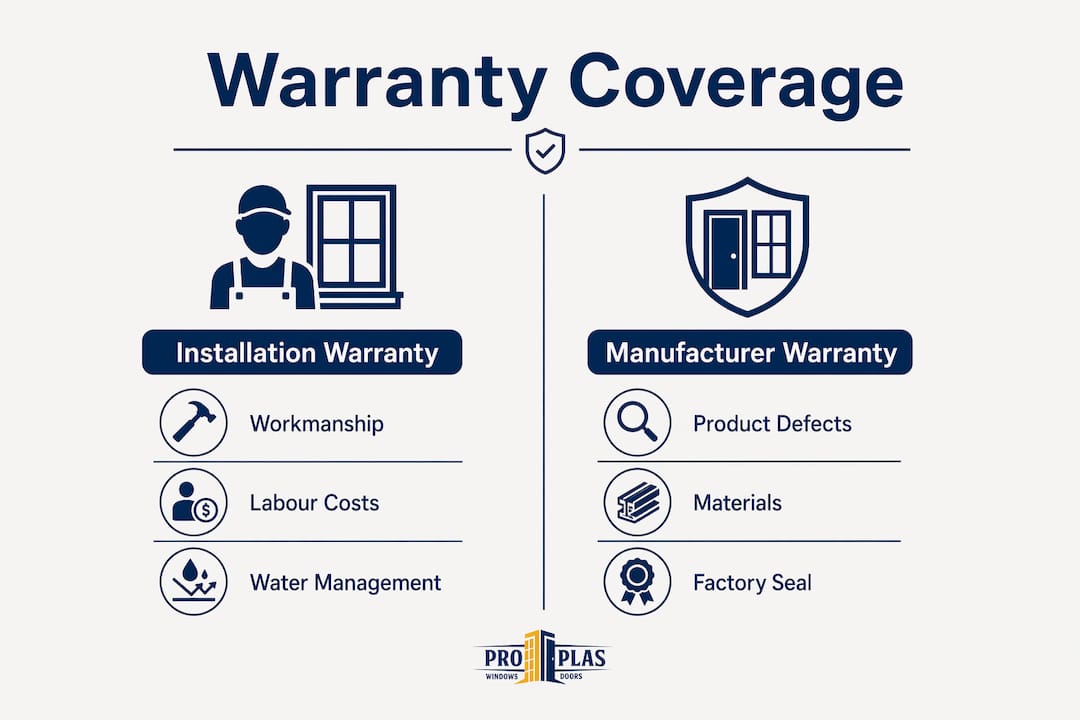
Window replacement warranties split into two distinct layers: the manufacturer warranty and the installer warranty. Each covers a different category of defect, and each is issued by a different party. Confusing the two leads to denied claims and out-of-pocket costs.

Here is how the two warranties divide responsibility:
| Coverage aspect | Installation warranty | Manufacturer warranty |
|---|---|---|
| Defects covered | Improper flashing, sealing failures, frame damage, fastener failure | Glass seal failure, hardware malfunction, material defects |
| Labour included | Yes, diagnosis and repair labour | Typically excluded |
| Warranty issuer | Your installer or contractor | The window manufacturer |
| Claim contact | Installer or installation company | Manufacturer’s warranty department |
The manufacturer warranty covers what comes out of the factory. If a glass unit fogs up due to a failed seal inside the unit, that is a product defect and the manufacturer handles it. If water is leaking around the frame because the flashing was installed incorrectly, that is an installation defect and the installer’s warranty applies.
Labour costs are covered under installation warranties but are typically excluded from manufacturer warranties. This matters because removing and reinstalling a window to fix a defect is expensive work. Without an installation warranty, you pay that labour cost yourself even if the underlying problem was the installer’s fault.
Symptom overlap between product and installation failures creates real confusion. Fogging, condensation, water staining, and air drafts can result from either a product defect or an installation error. Knowing which warranty applies requires identifying the root cause, which is why documentation from the start is so valuable.
Pro Tip: Ask your installer to walk you through which specific symptoms fall under their warranty versus the manufacturer’s warranty before any work begins. Get that explanation in writing.
Risk allocation and long-term protection
Construction warranties allocate responsibility for latent defects by specifying who pays for repairs that appear after the project is complete. This is the legal backbone of why installation warranties exist. Many installation problems do not show up immediately. They appear months or even years later, after seasonal temperature changes, heavy rain, or normal settling of the building.
The practical importance of installation warranty coverage breaks down into four clear areas:
- Labour cost protection. When an installation defect surfaces, the repair requires skilled labour to diagnose and fix. The installation warranty covers that cost so you do not pay out of pocket for a mistake you did not make.
- Latent defect coverage. Improper flashing or inadequate air sealing may not cause visible problems until the first hard winter. A workmanship warranty covers these hidden defects even when they appear well after installation day.
- Clear accountability. A written installation warranty names who is responsible for remediation. Without it, disputes about fault between the installer and the manufacturer can leave you waiting while the damage worsens.
- Financial predictability. Window replacement is a significant investment. An installation warranty protects that investment by removing the financial risk of workmanship errors from your shoulders.
Installer workmanship warranties are typically negotiated at the contract level with a baseline of one to two years, though this varies widely. There is no federal standardisation in Canada, so the practical value of your warranty depends entirely on what is written in your contract. Verify the exact scope and duration before you sign anything.
Pro Tip: Request a copy of the installation warranty document before the work begins, not after. Reviewing it upfront gives you time to ask questions and negotiate terms.
How to evaluate installation warranties before hiring a contractor
Reviewing an installation warranty is a procurement step, not an afterthought. Treat it the same way you would review a quote or a product specification. The questions you ask before hiring determine the protection you receive after installation.
Here are the key questions to ask every contractor:
- How long does the installation warranty last? One year is a minimum. Two years or more is better for catching latent defects.
- What specific defects does it cover? Confirm that improper flashing, sealing failures, air infiltration, and frame damage are explicitly included.
- Who issues and honours the warranty? Is it the installer directly, or a third party? If the company closes, what happens to your coverage?
- Are there registration requirements? Warranty claims processes differ depending on whether coverage is installer-issued or manufacturer-issued. Some warranties require registration within a set number of days.
- What conditions can void the warranty? Unauthorized repairs, poor maintenance, or failure to follow care instructions can void coverage entirely. Know the exclusions before you agree.
- Is the warranty transferable? If you sell your home, a transferable warranty adds real value for the buyer.
Once you have answers, ask for all warranty terms in writing as part of the signed contract. Verbal assurances carry no legal weight. The written contract is the only document that matters if a dispute arises.
Pro Tip: Cross-reference the warranty document against the scope of work in your contract. Every task listed in the scope of work should have a corresponding warranty coverage category.
Common installation issues covered and how claims work
Installation warranties typically cover workmanship errors including improper flashing, sealing failures, and fastener failure. These defects cause water leakage and air infiltration, which are distinct from product defects. Knowing what to look for helps you identify a valid claim early, before minor damage becomes major.
Common installation defects to watch for
- Water intrusion around the frame or sill, especially after heavy rain
- Visible gaps between the window frame and the rough opening
- Drafts or air movement around sealed edges
- Condensation between panes caused by a compromised seal at the frame level
- Difficulty opening or closing windows due to frame misalignment
How to file an installation warranty claim
- Document the problem immediately. Take dated photos of the defect and any resulting damage. Note when you first noticed the issue.
- Review your warranty document. Confirm the defect falls within the covered categories and that you are within the warranty period.
- Contact the installer in writing. Email creates a paper trail. Describe the defect clearly and reference your warranty terms.
- Request an inspection. A qualified inspection helps determine whether the defect is an installation error or a product failure. This step resolves attribution disputes.
- Keep all invoices and correspondence. If the claim escalates, your documentation is your strongest asset.
Verify warranty responsibility around water management work such as flashing, sill pan, and air barrier installation. These are the most common sources of installation claims and the most frequently disputed. Knowing who is responsible for each element of the rough opening interface prevents confusion when a claim arises.
Key takeaways
An installation warranty is your primary financial protection against workmanship defects that manufacturer warranties do not cover, and verifying its scope before signing a contract is the single most important step in any window replacement project.
| Point | Details |
|---|---|
| Two separate warranty layers | Manufacturer warranties cover product defects; installation warranties cover workmanship errors. |
| Labour costs matter | Installation warranties include labour; manufacturer warranties typically exclude it. |
| Latent defects are real | Many installation errors only appear months after completion, making warranty duration critical. |
| Contract terms determine value | There is no federal standard; your written contract defines your actual coverage. |
| Documentation protects claims | Dated photos, inspection reports, and written correspondence are required to support any claim. |
What 25 years of installations taught us about warranty gaps
Most homeowners focus on the product warranty when comparing window quotes. That is understandable. Manufacturer warranties are prominently advertised and easy to compare. Installation warranties are buried in contract language and rarely discussed at the sales stage.
The risk in that approach is real. Installation and product warranties operate as separate coverage tracks with different parties and different exclusion sets. Assuming one covers what the other misses is the most common and most costly mistake we see homeowners make.
The second mistake is treating the warranty review as a formality. Homeowners sign contracts quickly, skip the warranty document, and assume everything is covered. Then a leak appears 18 months later and nobody can agree on whose responsibility it is. That dispute is almost always avoidable with 20 minutes of review before signing.
Implied and express workmanship protections exist because many defects only reveal themselves after the buyer has committed. The installation warranty is the legal tool that allocates that risk fairly. Use it as such.
Store your warranty documents, inspection reports, and installation invoices in one place, whether that is a physical folder or a cloud folder. If you ever need to file a claim or sell your home, having that paperwork organised saves significant time and stress.
— Proplas
Proplas warranty coverage for window replacements
Proplas backs every window installation with clear, transparent warranty terms given to you before work begins. You know exactly what is covered, who handles remediation, and how to file a claim, with no surprises after the fact.

Our installers follow best practices for water management, flashing, and air sealing at every rough opening, which means fewer defects and fewer claims in the first place. With 25 years of experience and over 10,000 satisfied customers, we stand behind our workmanship. Explore our window installation services or visit Proplas to request a quote and review our warranty terms before you commit to anything.
FAQ
What is an installation warranty for windows?
An installation warranty is a written guarantee from your installer that covers defects caused by how your windows were installed, including improper flashing, sealing failures, and frame damage. It is separate from the manufacturer warranty, which covers product defects only.
Does installation warranty matter if I have a manufacturer warranty?
Yes. Manufacturer warranties exclude labour costs and do not cover workmanship errors. Without an installation warranty, you pay out of pocket for any repair caused by how the window was installed, even if the product itself is fine.
How long does an installation warranty typically last?
Installer workmanship warranties typically start at one to two years, though duration varies by contractor and contract terms. There is no federal standard in Canada, so always confirm the exact period in writing before signing.
What voids an installation warranty?
Unauthorized repairs, poor maintenance, and failure to follow care instructions are the most common reasons installation warranties are voided. Always check the exclusions section of your warranty document before doing any work near your windows.
How do I know if a problem is covered by the installation warranty or the manufacturer warranty?
Symptom overlap between installation and product failures makes this genuinely difficult. A professional inspection that identifies the root cause, whether it is a workmanship error or a product defect, is the most reliable way to determine which warranty applies.