

Customer service is the control point that turns a technical installation into a trusted homeowner outcome. When you replace windows or doors, the product itself is only part of what you’re buying. The service experience around it, from the first quote call to the 90-day follow-up, determines whether you feel confident in your investment or left wondering if something was done right. Proplas, with extensive experience and a large number of satisfied customers across Toronto and the GTA, builds its process around five service roles that every homeowner should expect:
- Clarify expectations before a single measurement is taken
- Handle scheduling and permits so you don’t have to chase paperwork
- Arrive professionally and protect your home on installation day
- Validate the installation with you before the crew leaves
- Follow up with warranty support and documented resolution paths
Industry analysis confirms that the setup experience is now read as part of product quality itself. A smooth installation builds immediate homeowner confidence in ways that the product spec sheet alone never can.
Table of Contents
- What should customer service do before installation day?
- What does excellent service look like on installation day?
- How should post-install support and warranty work?
- Why do integrated service records speed up issue resolution?
- How do you choose an installer with strong customer service?
- How Proplas applies these principles in Toronto and the GTA
- Key takeaways
- What homeowners often underestimate about installation service
- Get a quote from Proplas for your Toronto or GTA installation
- Useful sources for homeowners
What should customer service do before installation day?
The pre-install phase is where most homeowner frustration originates. Vague quotes, missed permit details, and poor scheduling communication create anxiety before anyone sets foot in your home.
A well-run company delivers a clear, itemised quote that spells out exactly what is included, what is excluded, and what actions on your part could affect the warranty. You should know the arrival window, the estimated duration, and the name of the lead technician before the day arrives. For projects requiring a building permit, your installer should coordinate that process and confirm it is in place before booking the job.
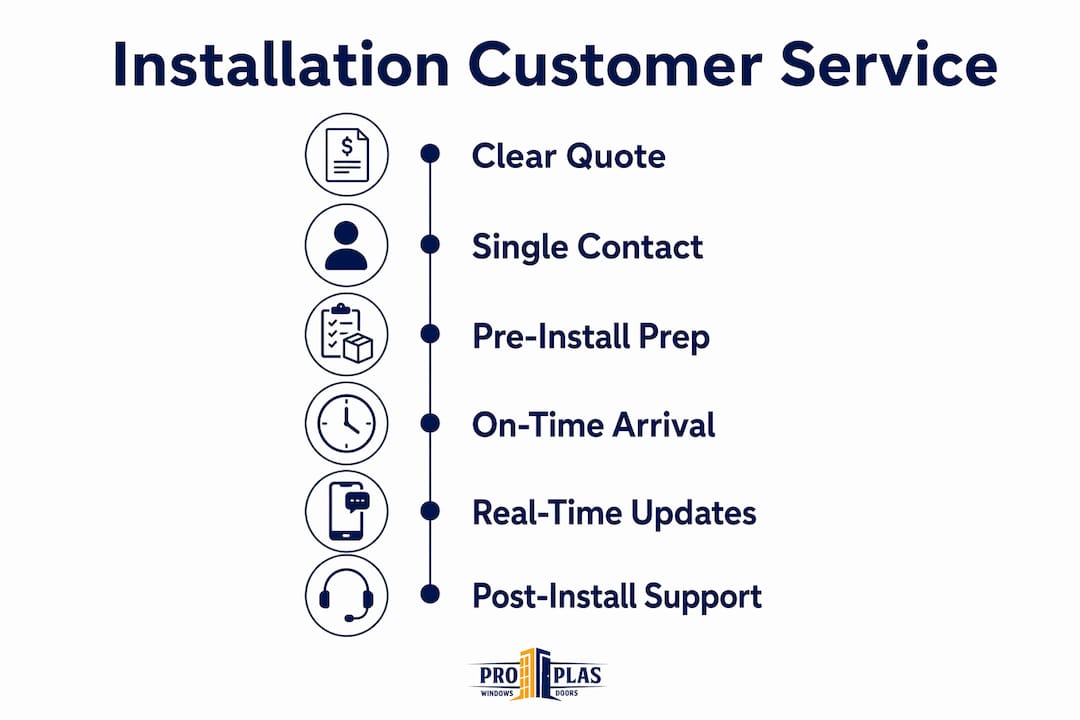
Presenting installation as a visible, documented benefit reduces confusion and lowers the chance of returns caused by setup misunderstandings. The pre-install conversation is where that clarity starts.
Your pre-install checklist should cover:
- Confirm measurements match the quote
- Clear the work area and move fragile items
- Arrange pet and child access away from the work zone
- Confirm parking access for the installation vehicle
- Receive a 24–48 hour reminder by SMS or email with the technician’s name
Pro Tip: Ask for a written timeline and a named single contact for your job. Fragmented handoffs between a sales rep, a scheduler, and an anonymous crew are one of the most common sources of day-of confusion. One name, one number, one written schedule.
You can also review how to prepare for window installation to make sure your home is ready before the crew arrives.
What does excellent service look like on installation day?
The home-arrival ritual is where trust is either built or lost in the first 90 seconds. A professional technician greets you by name, introduces themselves, puts on protective booties, and lays drop cloths before touching anything. This short sequence signals that your home will be treated with care, and practitioner data shows it lifts on-site review conversion to roughly 55–70% compared to 5–12% when the ask comes by delayed email.
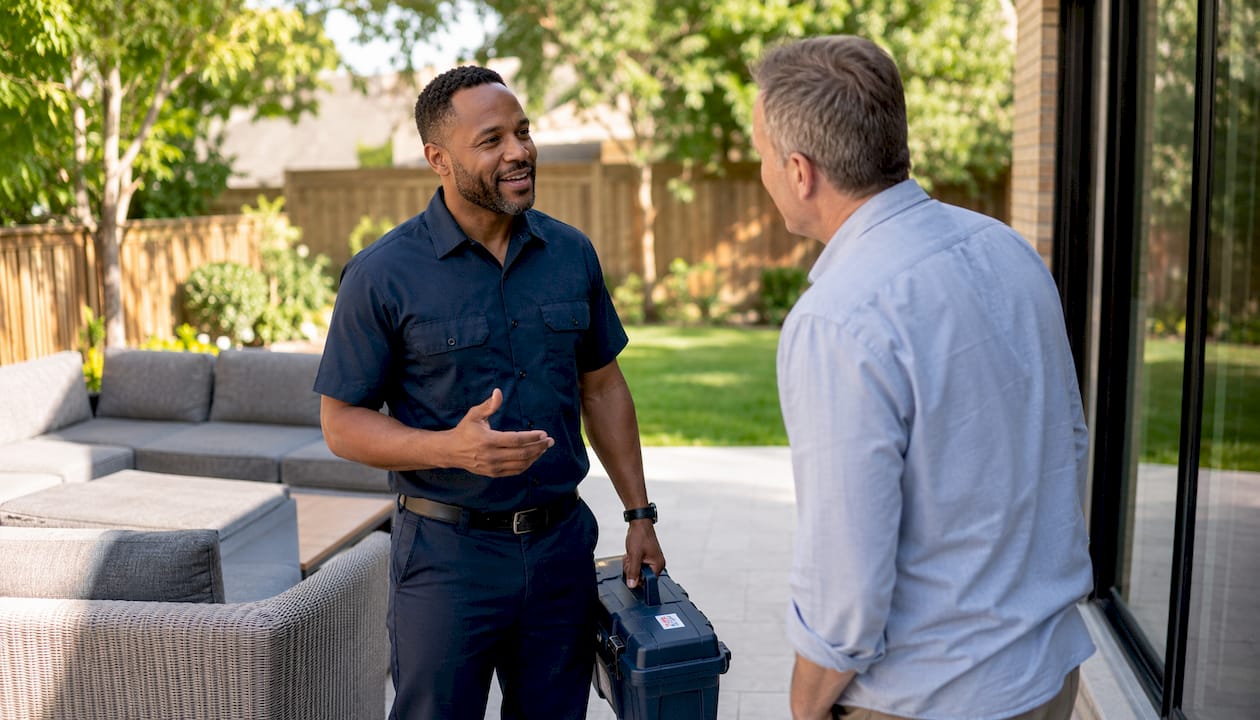
Real-time communication matters throughout the job. You should receive an estimated start time, a mid-job update if anything changes, and a final walkthrough before the crew signs off. That walkthrough is not optional. It is the moment you confirm the installation meets the agreed scope.
Documentation protects you. Before-and-after photos, a brief plain-language job summary, and a record of parts used give you a reference point if any question arises later. Sending before/during/after photos increases post-job review rates by approximately 40% and reduces price-objection callbacks by about 22%.
On-site verification steps every homeowner should insist on:
- Technician demonstrates how the new window or door operates
- You confirm the seal, hardware, and locking mechanism work correctly
- You receive a brief explanation of what to watch for in the first week
- The work area is cleaned and restored before the crew departs
- You sign off only after the walkthrough is complete
For guidance on reducing disruption during the job, see minimising home disruption during window replacement.
How should post-install support and warranty work?
The follow-up cadence is where most installers fall short, and where the best ones build lasting loyalty. A structured sequence prevents the silent confusion that turns minor issues into negative reviews.
A recommended post-install follow-up looks like this:
- Day 1: Thank-you contact confirming the job is complete and providing warranty documentation
- Day 7: Operational check to confirm the window or door is functioning correctly
- Day 30: Performance follow-up, especially relevant for Energy Star certified products where energy savings should be noticeable
- Day 90: Advocacy conversation and an invitation to share feedback
Practitioner guidance supports this structured cadence as the most reliable way to prevent confusion and build referrals.
Your warranty documentation should clearly state what the installation warranty covers, how to file a claim, and the typical timeline for adjustments. Proplas backs its work with a lifetime installation warranty, and you can review why installation warranty matters before signing any agreement.
Pro Tip: Ask for a leave-behind sheet that explains basic maintenance and lists a direct number for common post-install adjustments. A company confident in its work will provide this without hesitation.
Why do integrated service records speed up issue resolution?
When a post-install issue arises, the last thing you want is to repeat your story to three different people, as emphasized by the Services – REPS of Texas approach to integrating customer service with installation records. Integrated service and installation data allows a support representative to see your installation history, the parts used, the technician’s notes, and prior visits, all in one place. That context cuts resolution time and eliminates the frustration of fragmented support.
Useful records a well-run company should maintain for your job:
- Before/during/after job photos
- Parts and product serial numbers used
- Technician notes and any on-site decisions made
- Warranty start date and coverage scope
- A reference number tied to your specific installation
From a homeowner’s perspective, the practical benefit is a single reference number and a documented resolution path. You call once, the rep sees everything, and the issue moves forward without delay.
| Record type | Homeowner benefit |
|---|---|
| Job photos | Visual proof of condition before and after |
| Parts log | Confirms correct products were installed |
| Technician notes | Explains any on-site decisions or changes |
| Warranty start date | Anchors your coverage period clearly |
| Prior visit history | Prevents repeated explanations on callbacks |
How do you choose an installer with strong customer service?
Selecting the right installer comes down to asking the right questions before you commit. The answers reveal whether a company’s service process is structured or improvised.
Pre-qualification questions to ask every installer:
- What does your installation warranty cover, and for how long?
- Are your products Energy Star certified for Canadian climate zones?
- Can you provide proof of technician training or certification?
- Will I receive an itemised quote in writing?
- Who is my single point of contact from booking to follow-up?
Request these in writing before signing anything:
- Itemised quote with scope of work
- Timeline commitment with arrival window
- Cancellation and late-arrival policy
- Post-install follow-up plan
Red flags that signal a poorly run operation:
- Vague or verbal-only timelines
- No written warranty or warranty that excludes installation labour
- Multiple contact points with no named lead
- No mention of photo documentation or post-job walkthrough
Pro Tip: Ask the company to walk you through their post-install support process in plain language. A confident, specific answer tells you the process is real. A vague or deflected answer tells you it is not.
| Evaluation criterion | What to look for |
|---|---|
| Warranty clarity | Written, covers both product and installation labour |
| Certification | Energy Star products, trained and certified technicians |
| Communication | Named contact, written timeline, 24-hour reminder |
| Documentation | Before/after photos, job summary, parts record |
| Follow-up plan | Structured cadence, not just “call us if there’s a problem” |
For door-specific selection guidance, see choosing an entry door installation company.
How Proplas applies these principles in Toronto and the GTA
Proplas delivers on every criterion in the checklist above. With extensive experience and a large number of satisfied customers, the company offers Energy Star certified windows and doors, trained technicians, and a lifetime installation warranty backed by transparent, itemised quotes.
Key service commitments homeowners in Toronto and the GTA can expect from Proplas:
- Itemised quotes with no hidden fees
- Installation timelines often as quick as three days
- A named technician and a single contact from booking to follow-up
- Before/during/after photo documentation on every job
- A lifetime installation warranty with clear claim procedures
- Energy Star certified products suited to Canadian climate conditions
Small operational disciplines compound over time. Proplas runs structured technician training that covers the home-arrival ritual, the post-job walkthrough, and the documentation process, so the service experience is consistent across every job, not dependent on which crew shows up.
Key takeaways
Strong customer service in window and door installation requires verified warranties, documented communication, and a structured follow-up plan from day one to day 90.
| Point | Details |
|---|---|
| Verify warranties in writing | Confirm both product and installation labour are covered before signing. |
| Expect the home-arrival ritual | A professional crew introduces themselves, uses protective gear, and lays drop cloths before starting. |
| Insist on photo documentation | Before/during/after photos protect you and speed up any post-install resolution. |
| Get a follow-up plan | A structured day 1, 7, 30, and 90 cadence prevents silent issues from becoming complaints. |
| Proplas delivers all five | Proplas offers itemised quotes, Energy Star products, trained technicians, and a lifetime installation warranty in Toronto and the GTA. |
What homeowners often underestimate about installation service
The home-arrival ritual gets dismissed as a nicety. It is not. The 60–90 seconds a technician spends introducing themselves, putting on booties, and laying drop cloths before touching anything is the moment a homeowner decides whether to trust the crew in their home. Technical skill matters, but that ritual earns permission to demonstrate it.
The same logic applies to the post-install walkthrough. Most homeowners accept a verbal “all done” and move on. The ones who insist on a demonstration of the new window or door, a confirmation that the seal and hardware work correctly, and a leave-behind sheet with maintenance notes are the ones who rarely need to call back with problems. Advocating for yourself at that moment costs nothing and prevents most post-install confusion.
If an issue does arise and the first contact does not resolve it, ask politely but directly: “Can you escalate this to a supervisor and confirm a resolution timeline in writing?” That single sentence moves most unresolved issues forward faster than any amount of follow-up calling.
Get a quote from Proplas for your Toronto or GTA installation
Proplas gives Canadian homeowners a clear, no-surprise path from quote to completed installation. No hidden fees, no vague timelines, and no anonymous crews. You receive an itemised quote, a named technician, Energy Star certified products, and a lifetime installation warranty backed by 25 years of local experience.
After you request a quote at proplas.ca, a Proplas representative contacts you to schedule a site visit. You receive a written estimate, a confirmed booking, and a pre-install checklist so the day runs without friction. View completed projects in the Proplas portfolio or explore window options and door options before your consultation.
Useful sources for homeowners
- Why setup experience is now part of product quality — industry analysis on how the installation experience shapes homeowner perception of product quality.
- Study on service integration and customer experience — research on how integrated service records reduce repeat questioning and speed issue resolution.
- Contractor customer service training: Boost your reviews — practitioner guidance on home-arrival rituals, photo documentation, and review conversion rates.
- The solar customer journey after installation — structured post-install follow-up cadence applicable to any home installation service.
- When your customers aren’t technical: guiding setup and enablement at scale — guidance on building homeowner capability through documentation and leave-behind materials.
- Proplas installation warranty information — Canada-specific warranty terms and what homeowners should confirm before signing.