

Hidden fees in a renovation are costs that contractors routinely leave out of base quotes — permits, disposal, material waste, change-order markups, and structural surprises — and they show up on your invoice mid-project when you have the least leverage. The fastest way to limit your exposure is to insist on a fully itemised quote, a written change-order policy, and a contingency buffer before you sign anything.
Many homeowners exceed their initial renovation budget because standard quotes cover only core labour and primary materials while excluding predictable auxiliary costs. That gap is not always dishonesty. Often it is structural: contractors price what they can see and defer the rest.
Scan any estimate immediately for these high-impact omissions:
- Permit and inspection fees (frequently listed as “owner’s responsibility”)
- Debris removal and dumpster rental
- Material waste allowances (tile, drywall, flooring)
- Utility or code-compliance upgrades triggered by the permit
- Structural repairs discovered once walls open
- Change-order markups on any scope additions
- Design, engineering, or survey fees
- HST on labour and materials
Table of Contents
- Why do standard contractor quotes miss so many predictable costs?
- What are the most common hidden fees Canadian homeowners encounter?
- How do you spot missing items in a quote before you sign?
- How should you set a contingency and material allowances?
- What should you do when unexpected costs appear mid-project?
- What hidden fees are specific to window and door projects?
- Key takeaways
- Why transparent pricing prevents most renovation disputes
- No hidden fees on your next window or door project
Why do standard contractor quotes miss so many predictable costs?
Most low bids are incomplete by design or by structure, not necessarily by deception. A contractor competing on price has an incentive to present the lowest possible number upfront and resolve the gaps later through change orders and allowance adjustments.

The mechanics work like this. Allowances are placeholder numbers for materials you have not yet selected — cabinets, tile, fixtures, windows. Underfunded allowances for finishes are the single most common cause of mid-project budget overruns. A contractor might set a $2,000 tile allowance knowing most homeowners end up spending $4,500 once they see options in person. The difference becomes a change order.
Scope ambiguity compounds the problem. Vague line items like “bathroom renovation — supply and install” leave enormous room for interpretation. When you ask about disposal, the answer is often “that’s extra.” When you ask about permits, the answer is “we can handle that for an additional fee.”
“In most cases, the answer isn’t that your contractor was dishonest. It’s that your budget didn’t account for the costs that aren’t in a standard construction quote — permits treated as extras, material allowance overages, discovery items behind walls, change orders during construction, and soft costs that most homeowners don’t know exist until they meet them.” — SilverBullet Inc.
Provincial permit variability makes this worse in Canada. Permit fees and the code upgrades they trigger differ significantly between municipalities. A bathroom addition in one Ontario city might require an electrical panel upgrade; the same project in a neighbouring municipality might not. Contractors working across regions often exclude permits entirely rather than guess at the local fee schedule, shifting that administrative and financial burden to you.
What are the most common hidden fees Canadian homeowners encounter?
The renovation cost breakdown below covers the categories that appear most often on surprise invoices. Knowing the typical impact range helps you spot an incomplete bid before you sign.
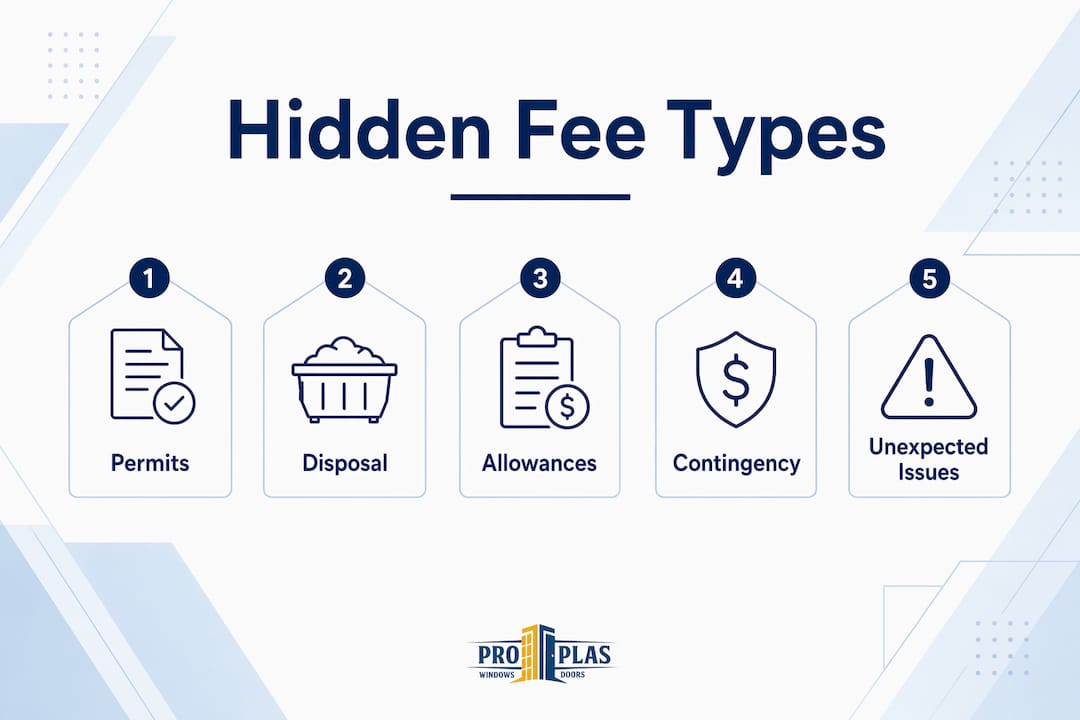
| Fee category | Why it gets missed | Typical impact range |
|---|---|---|
| Permits and inspections | Often listed as “owner’s responsibility” or excluded entirely | $500–$3,000 for significant renovations (varies by scope and municipality) |
| Debris removal and dumpster | Treated as a separate trade or excluded from scope | $300–$1,500 depending on project scale |
| Material waste | Not priced into base quote; shortages appear mid-project | 10–15% overage for tile/flooring, 8–12% for drywall, resulting in added material costs |
| Structural surprises | Invisible until demo begins | rewiring and mold remediation costs vary widely depending on extent and specifics |
| Code-compliance upgrades | Triggered by permit; not visible at estimate stage | panel upgrades and plumbing to code may add several thousand dollars depending on scope |
| Change-order markups | Full overhead and profit applied to each addition | can add a moderate percentage of the project cost cumulatively |
| Design and engineering fees | Excluded when contractor does not offer design-build | architectural drawings can add a few thousand dollars depending on scope |
| Soft costs | Storage, temporary housing, meals during construction | storage and other soft costs vary depending on project duration and needs |
| HST | Applied to labour and materials; sometimes omitted from estimates | a provincial sales tax applies on most renovation services |
Canada-specific note: Provincial holdback rules require you to withhold a percentage of each progress payment (10% in Ontario under the Construction Act) until the lien period expires. Confirm with a local professional, as rules vary by province. Permit fees themselves are often modest, but the code upgrades they trigger — seismic retrofits, egress windows, panel upgrades — are where the real cost lives.
Older homes carry the highest structural risk. Pre-1980 properties commonly hide asbestos, lead paint, and failing plumbing that only surface once demolition starts. Budget accordingly before you open a single wall.
How do you spot missing items in a quote before you sign?
Ask for a fully itemised bid that breaks out labour, materials, permits, disposal, and allowances as separate line items. A quote that bundles everything into one number gives you no way to compare bids or identify what is missing.
Bid review checklist — go through this line by line:
- Is HST shown separately, or is it buried in the total?
- Are permits listed as included, excluded, or “owner’s responsibility”?
- Is debris removal and dumpster rental a named line item?
- Are allowances stated as specific dollar amounts per category (not “TBD”)?
- Is there a written change-order clause with a stated markup rate?
- Are subcontractor costs itemised or lumped into a single trade line?
- Does the quote specify who pulls permits and who attends inspections?
Questions to ask every contractor before signing:
- “What is not included in this quote?”
- “How do you handle discoveries behind walls — what is the process and who approves the cost?”
- “What is your change-order markup rate?”
- “Are permits included, and which municipality will you be pulling them from?”
Red flags to watch for: vague scope descriptions, allowances marked “to be confirmed,” verbal-only promises about inclusions, and a quote that is significantly lower than others without a clear explanation of what was removed.
Pro Tip: Ask each bidder to walk you through the three most likely discoveries on your specific project and how they would price them. A contractor who has a clear, confident answer has done this before. One who deflects or says “we’ll deal with it if it comes up” is telling you something important about how change orders will be handled.
How should you set a contingency and material allowances?
Professional budgeting guidance recommends structuring a contingency buffer across risk categories rather than adding a single round number on top of the quote. The right buffer size depends on your home’s age and the scope of work.
| Project type | Recommended contingency |
|---|---|
| Cosmetic renovation, newer home | 15% above quoted cost |
| Mid-range renovation, typical home | 15–20% above quoted cost |
| Gut renovation or pre-1980 home | 20–25% above quoted cost |
| Historic or older home | 20–25% above quoted cost |
How to allocate a 20% contingency on a $60,000 kitchen renovation:
- Permits and inspections: $1,500 (set aside regardless of whether the contractor includes them)
- Material waste and overage: $1,800 (covers the gap between allowance and actual selection)
- Structural risk: $4,500 (higher if the home is pre-1980)
- Code-compliance upgrades: $2,000 (electrical panel, plumbing)
- Remaining buffer: $2,200 (change orders you initiate, soft costs)
For material allowances specifically, document the dollar amount per category in the contract before signing. If the tile allowance is $3,500, write that number into the agreement. When your selections exceed it, the change order is expected and pre-authorised up to a stated threshold. That one step prevents most mid-project allowance disputes. Detailed window upgrade budget planning follows the same principle: set the allowance in writing before installation day.
What should you do when unexpected costs appear mid-project?
Stop, document, and ask for written justification before approving any new charge. A verbal “we found something” conversation is not a change order.
- Request a written change order that describes the new scope, the reason it was not in the original quote, and the itemised cost including labour, materials, and markup rate.
- Ask for subcontractor receipts on any material or trade cost above a threshold you set in the contract (a common threshold is $500).
- Get a second opinion on large structural discoveries before approving remediation. A $15,000 “rot repair” quote deserves an independent assessment.
- Use holdback as leverage. In Ontario, the Construction Act requires a 10% holdback on each progress payment. Do not release holdback early, and confirm the lien period has expired before final payment.
- Escalate when necessary. For disputes that cannot be resolved directly, options include your provincial consumer protection office, the local building department (for permit or code disputes), or small claims court for amounts within the applicable limit. Rules differ by province, so confirm the right channel for your situation.
A common bathroom renovation mistake is approving verbal change orders under pressure and then disputing the invoice after the fact. Written documentation protects both parties.
What hidden fees are specific to window and door projects?
Window and door replacements carry their own set of unexpected renovation expenses that rarely appear on a first estimate. Custom sizing, retrofit preparation, frame repairs, and disposal are the four most common omissions.
Require these itemised lines on any window or door estimate:
- Custom sizing premium (non-standard rough openings almost always cost more)
- Removal and disposal of existing units
- Frame inspection and repair (rot, water damage, structural damage around the opening)
- Flashing, weatherproofing, and air sealing
- Permit handling, where required by the municipality
- Interior and exterior trim, caulking, and finishing
- Warranty terms in writing, including what voids coverage
Pro Tip: Before accepting any window or door quote, ask the installer to confirm the rough opening dimensions on-site, not from a floor plan. Measurements taken from drawings are often off by enough to trigger a custom-size charge. A reputable installer will measure in person before quoting.
Proplas provides fully itemised quotes that break out each of these lines separately, so you know exactly what is included before installation begins. Their window installation checklist covers site prep, removal, flashing, and finishing as standard deliverables, not add-ons. Understanding what a retrofit installation involves helps you confirm whether your project needs full-frame replacement or a retrofit approach, and what each option includes.
Key takeaways
Hidden fees in renovation are predictable and preventable when you insist on itemised quotes, written change-order policies, and a contingency buffer sized to your home’s age and project scope.
| Point | Details |
|---|---|
| Get an itemised quote | Every cost category — permits, disposal, allowances, HST — must appear as a separate line before you sign. |
| Set a contingency buffer | For a typical renovation, budget 15–20% above the quoted cost; for gut renovations or pre-1980 homes, budget 20–25%. |
| Document allowances in writing | State the dollar amount per material category in the contract to prevent mid-project surprises. |
| Require written change orders | Never approve new scope verbally; insist on a written order with itemised costs and markup rate. |
| Proplas transparent pricing | Proplas provides fully itemised window and door quotes with no hidden fees, covering removal, installation, and warranty as standard. |
Why transparent pricing prevents most renovation disputes
The pattern we see consistently across renovation projects is that disputes rarely start with a single large surprise. They accumulate: a permit fee here, a disposal charge there, an allowance that was always going to come up short. By the time a homeowner realises the budget has slipped, the contractor is already three weeks into the job and the leverage is gone.
The checklist and budgeting rules in this article are not theoretical. They reflect what experienced contractors already know and what homeowners deserve to know before signing. A contractor who resists providing an itemised quote or a written change-order policy is not protecting their process. They are protecting their margin.
Proplas has delivered transparent, itemised pricing to over 10,000 homeowners across Toronto and Southern Ontario over 25 years. That track record is built on one straightforward principle: you should know exactly what you are paying for before installation day, not after.
No hidden fees on your next window or door project
Proplas gives Toronto and Southern Ontario homeowners the one thing most renovation quotes leave out: complete clarity on cost before work begins.
Every Proplas quote itemises removal and disposal, site preparation, custom sizing, flashing and weatherproofing, and permit handling where applicable. There are no allowance surprises, no change-order ambiguity, and no fees that appear after you have signed. Energy Star certified windows and doors are backed by a lifetime warranty, and installation typically completes in as little as three days.
Ready to see exactly what your project costs? Request an itemised quote from Proplas today, with no obligation and no surprises.