

A window performance guarantee is a written warranty that defines exactly what parts, workmanship, and timeframes you can rely on after a window replacement. Two separate documents govern your protection: the manufacturer (product) warranty, which covers defects in materials and components, and the installer (workmanship) warranty, which covers errors made during installation. Understanding why installation warranty matters is just as critical as reading the product warranty itself.
Three things most affect your outcome as a homeowner:
- Coverage scope: Does the warranty cover both parts and labour, or parts only?
- Term and prorating: When does prorating begin, and what percentage do you pay after year five or ten?
- Transferability and exclusions: Does coverage transfer to a new owner, and what voids it?
Before you sign anything, verify these three clauses in the contract:
- Labour inclusion and its duration (not just parts)
- The prorating schedule, written as a percentage table
- Transferability conditions and any registration deadline
Pro Tip: Ask the installer to walk you through a sample claim scenario in writing before you sign. Their response reveals far more about real coverage than the warranty document alone.
Table of Contents
- What does a window warranty typically cover?
- Performance Grade vs. warranty: what each one actually guarantees
- Common exclusions and marketing traps to watch for
- How to compare two warranty documents side by side
- How to make a warranty claim in Canada
- How Proplas structures its performance guarantee
- Key takeaways
- What installers actually see go wrong with warranty claims
- Proplas backs your window replacement with a clear, written guarantee
- Useful sources and references
What does a window warranty typically cover?
Window replacement warranties are structurally divided into two categories, and knowing which party to contact for each type of failure saves significant time and money.
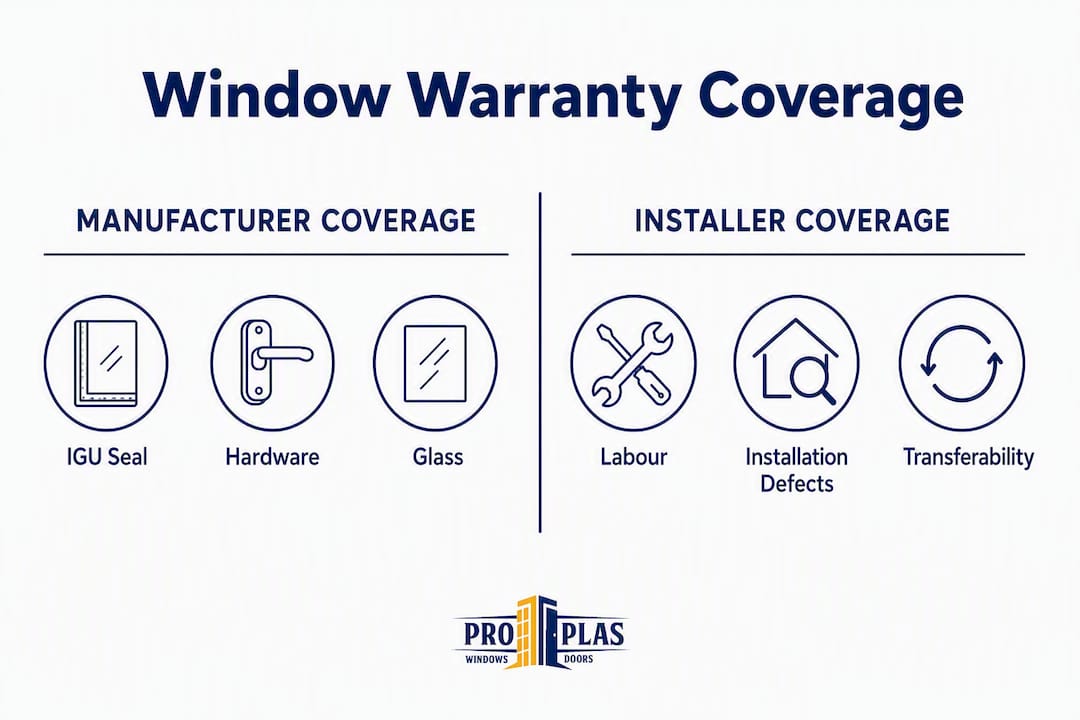
Manufacturer coverage addresses defects that originate in the factory: insulated glass unit (IGU) seal failures, frame and sash defects, hardware malfunctions, finish degradation, and screen defects. Installer (workmanship) coverage addresses errors made on-site: improper flashing, air and water infiltration caused by poor fastening, and sealant failures at the rough opening.
Common coverage items and realistic timeframes:
- IGU seals: 10–20 years is typical, with prorating often beginning after the first 5–10 years.
- Frames and sashes: Frequently described as “lifetime,” but the definition varies by provider and should be confirmed in writing.
- Hardware (locks, hinges, operators): Commonly covered for 1–5 years, typically non-prorated.
- Finishes and coatings: Coverage is usually 5–10 years, with some exclusions for damage caused by harsh cleaners.
- Screens: Generally covered for 1–2 years, and not usually prorated.
- Weather seals: Typically covered for a limited period, then treated as a homeowner maintenance item.
The table below shows how coverage and prorating are most commonly structured by component type.
| Component | Typical term | Prorating common? | Who covers it |
|---|---|---|---|
| IGU seal (glass unit) | 10–20 years, often prorated after 5–10 years | Yes | Manufacturer |
| Frame and sash | “Lifetime” (verify meaning) | Sometimes | Manufacturer |
| Hardware | 1–5 years | Rarely | Manufacturer |
| Finish/coating | 5–10 years | Sometimes | Manufacturer |
| Screens | 1–2 years | No | Manufacturer |
| Workmanship/labour | 1–10 years | Rarely | Installer |
Prorating means you absorb a growing share of replacement costs as the window ages. A seal that fails late in the prorated warranty period may leave you paying a significant portion of the glass replacement cost out of pocket. Always request the prorating schedule as a written percentage table, not a verbal summary.
Performance Grade vs. warranty: what each one actually guarantees
A Performance Grade (PG) and a warranty are not the same thing, and confusing them is one of the most common mistakes homeowners make. A PG rating indicates that a window specimen passed a coordinated battery of structural loading, air leakage, water penetration resistance, and operation tests under the AAMA/WDMA/CSA 101/I.S.2/A440 standard (also called NAFS). A warranty is a legal promise about remedies if something fails in your home.

Neither substitutes for the other. A high PG does not mean the manufacturer will replace a failed seal. A strong warranty does not mean the window will perform adequately in a high-wind or high-moisture Canadian climate.
Key terms to recognise:
- Energy Star: — A certification confirming a product meets climate-zone energy efficiency thresholds for Canada
When matching ratings to your home, consider your local wind load, driving rain exposure, and heating degree days. Southern Ontario homes face different thermal demands than coastal or northern sites.
Pro Tip: Never select a window solely because it carries the highest PG number available. A PG 40 window installed correctly in a typical Toronto home outperforms a PG 60 window with poor flashing and no workmanship warranty.
Common exclusions and marketing traps to watch for
Many warranty disputes trace back to language homeowners did not read carefully before signing. Manufacturer warranty documents commonly exclude caulking between the window and exterior cladding, treating it as a homeowner maintenance item rather than a product component. Gas retention in IGUs is another frequent disclaimer: manufacturers may warrant the seal but not guarantee argon or krypton fill levels over time.
Watch for these specific red flags:
- “Lifetime” without a definition: Lifetime warranties can mean anything from five years to a true lifetime; always ask for the term in years
- Labour excluded entirely: A parts-only warranty leaves you paying installation costs on every claim
- Prorating with no written schedule: Vague language like “reduced coverage over time” is unenforceable
- Original-owner-only coverage: No transferability means the warranty disappears the moment you sell
- Third-party extended warranty vendors: These are separate contracts with separate exclusions; read them independently
- Vague service windows: “We will respond in a reasonable time” is not a commitment; request a specific number of business days in writing
Conditions that commonly void coverage include power washing window frames, applying aftermarket films or coatings not approved by the manufacturer, and failing to perform documented maintenance. If you are considering a low-E window film after installation, confirm with your manufacturer that it does not conflict with your warranty terms before applying it.
Pro Tip: Before signing, ask the seller: “If my IGU seal fails in year eight, walk me through exactly what I pay and what you cover.” Request their answer in writing. A confident installer answers immediately; a vague one is a warning sign.
How to compare two warranty documents side by side
Use this checklist when reviewing competing offers. Record answers in a simple spreadsheet with one column per provider.
- Who issues each warranty: the manufacturer, the installer, or both?
- Which components are explicitly named as covered?
- Is labour included, and for how many years?
- What is the prorating schedule, expressed as a percentage table?
- Does coverage transfer to a subsequent owner, and under what conditions?
- Is registration required, and what is the deadline after installation?
- Are there maintenance requirements that must be documented to preserve coverage?
- Who is the claim contact: a local office or a national call centre?
- What is the stated inspection timeline after a claim is submitted?
Prioritise labour inclusion and IGU seal coverage above all other terms. A window warranty coverage guide can help you map these items to your specific window types. Hardware coverage matters most for casement and double-hung windows with moving parts; frame coverage matters most for long-term structural integrity.
How to make a warranty claim in Canada
Follow these steps to give your claim the best chance of success.
- Identify the responsible party. Determine whether the failure is a manufacturing defect (contact the manufacturer) or an installation error (contact the installer). Review your contracts to confirm which warranty applies.
- Gather your original invoice and contract. You need the purchase date, product model numbers, and installer details. Keep these in a dedicated folder from day one.
- Take dated photographs. Capture the failure clearly: condensation between panes, visible seal failure, hardware malfunction, or water infiltration marks. Photograph the full window and close-up details.
- Record weather and incident notes. Note dates, temperatures, and any events (heavy rain, ice storm) that preceded the failure. This context matters during inspection.
- Submit your claim in writing. Email or registered mail creates a time-stamped record. State the product, purchase date, nature of the failure, and your requested remedy.
- Follow the inspection process. Most manufacturers and installers require an on-site inspection before authorising repair or replacement. Confirm the inspection timeline in writing.
- Track prorating deadlines. If your warranty prorates at year ten and you are in year nine, act before the anniversary date to maximise your cost recovery.
Pro Tip: Send all claim correspondence by email and keep every reply. If you use the phone, follow up immediately with a written summary of what was discussed. A paper trail is your strongest protection if a claim is disputed.
Common outcomes after inspection: repair of the failed component, full replacement of the IGU or hardware, or a decline with a written explanation. If a claim is declined, request the specific warranty clause cited and compare it against your contract language.
How Proplas structures its performance guarantee
Proplas separates manufacturer product coverage from its own workmanship warranty clearly, so you always know which party is responsible and who to call. The manufacturer covers component defects: IGU seals, frames, hardware, and finishes. Proplas covers the installation itself: flashing, fastening, air and water sealing at the rough opening, and the labour required to correct any installation-related failure.
Key proof points homeowners routinely ask about:
- Many years in business serving Toronto and Southern Ontario
- thousands of satisfied customers across residential replacement projects
- Energy Star certified products across the full window and door range
- rapid installation timelines, often completed quickly
- a long-term warranty on workmanship, with clear written terms
Transferability and registration details are provided in writing at the time of installation. Proplas’s customer service approach means claim contacts are local, not routed through a national call centre, which shortens inspection timelines considerably.
Key takeaways
A window performance guarantee only protects you as well as its written terms; labour inclusion and IGU seal coverage are the two clauses that determine whether a warranty is genuinely useful or mostly marketing.
| Point | Details |
|---|---|
| Two warranties, not one | Always collect both a manufacturer warranty and an installer workmanship warranty in writing. |
| Labour inclusion is critical | A parts-only warranty leaves you paying installation costs on every repair claim. |
| “Lifetime” needs a definition | Ask for the term in years and request the prorating schedule as a written percentage table. |
| Keep records from day one | Store your invoice, photos, and all written correspondence in a dedicated folder throughout ownership. |
| Proplas lifetime warranty | Proplas backs its installations with a lifetime workmanship warranty and Energy Star certified products for Toronto and Southern Ontario homeowners. |
What installers actually see go wrong with warranty claims
Most warranty disputes Proplas encounters are not about whether a product failed. They are about documentation. Homeowners who cannot produce a dated invoice, a model number, or a photograph of the failure at the time it occurred face an uphill process regardless of how strong their written warranty is. The second most common issue is misrouting: contacting the installer for a manufacturing defect, or contacting the manufacturer for a workmanship failure. Both parties have legitimate grounds to redirect the claim, and the homeowner loses weeks in the process.
The clearest signal of a trustworthy installer is not the length of their warranty. It is how specifically they answer the question: “What happens if my IGU seal fails in year twelve?” An installer who answers with a precise process, a named contact, and a written timeline has thought through their obligations. One who answers with “we stand behind our work” has not.
Proplas backs your window replacement with a clear, written guarantee
Replacing windows is a significant investment, and the warranty behind that investment should be just as solid as the product itself. Proplas provides Toronto and Southern Ontario homeowners with custom windows matched to their home and climate, backed by a lifetime workmanship warranty and Energy Star certified products with no hidden fees.

You can request a sample warranty document before committing to anything. Proplas walks you through registration steps, coverage terms, and claim contacts at the time of installation, so nothing is left to interpretation. Whether you are comparing casement, double-hung, or picture windows, the warranty terms are the same: clear, written, and local.
Contact Proplas to schedule a site inspection, request written warranty documents, or get a no-obligation quote for your replacement project.
Useful sources and references
These authoritative resources support the standards, definitions, and warranty examples referenced throughout this article.
- AAMA/WDMA/CSA 101/I.S.2/A440 (NAFS standard): The North American Fenestration Standard defining PG, DP, and test methods for windows and doors sold in Canada
- How to read window performance ratings: Plain-language explanation of PG, DP, and how to apply ratings to real-world conditions
- Window Replacement Warranties: Manufacturer and Installer Coverage Explained: Detailed breakdown of what each warranty type covers and typical timeframe ranges
- What To Know About Window Warranties (This Old House): Consumer-focused overview of warranty variability, “lifetime” definitions, and transferability rules
- Proplas: window warranty coverage explained for Canadian homeowners: Coverage items, timeframes, and common exclusions specific to Canadian replacement projects
- Proplas: window warranty claim process guide: Step-by-step claims workflow tailored to Canadian homeowners
To verify a window’s PG or NFRC label, locate the certification sticker on the frame or sash and cross-reference the model number against the manufacturer’s published product data sheet. For Energy Star certification status in Canada, the Natural Resources Canada Energy Star product list is the primary verification source.