

For most Canadian homes, high-quality double-pane Low-E with argon gas and warm-edge spacers is the best cost-to-performance choice. Triple-pane is worth the investment in the coldest climate zones, or when condensation control and noise reduction are priorities. The key is knowing which numbers to ask for before you sign anything.
Here are the concrete targets to request from any supplier:
- Whole-window U-factor (W/m²·K): Ask for the NFRC-certified whole-window value, not just the centre-of-glass figure. For Ontario, target 1.1–1.4 W/m²·K for high-performance double-pane Low-E argon and 0.6–0.9 W/m²·K for triple-pane units.
- SHGC by orientation: South-facing windows benefit from a higher SHGC (0.35–0.55) to capture passive solar heat in winter. North-facing windows should prioritise the lowest U-factor available, with SHGC less critical.
- Air leakage: Look for ≤0.2 L/s·m² at 75 Pa on the NFRC label. Lower is better.
- Centre-of-glass vs whole-window: Centre-of-glass U-factors are always better than whole-window values. Whole-window ratings account for frame, spacer, and edge losses and are the only reliable purchasing metric.
ENERGY STAR Canada requires NFRC test methods and sets climate-zone-specific U-factor and SHGC thresholds. Any window you consider should carry both certifications.
Table of Contents
- How window performance is actually measured
- How glazing, coatings, and gas fills change insulation performance
- How frame materials affect whole-window thermal performance
- How to read NFRC and ENERGY STAR labels correctly
- Typical U-value targets for Canadian climates, with Ontario examples
- Why installation quality determines whether rated performance is ever achieved
- When does higher-performance glazing actually pay off?
- Retrofit and temporary options: what they can and cannot do
- How to choose the right window: questions to ask and red flags to watch for
- Key takeaways
- Proplas’s perspective on what the numbers miss
- Ready for an NFRC-backed quote from Proplas?
- Sources and further reading
How window performance is actually measured
Understanding the metrics on a window label is the first step in any meaningful window insulation performance comparison. There are five numbers that matter.
U-factor (W/m²·K) measures how quickly heat escapes through the window assembly. Lower is better. It is the inverse of R-value: R = 1/U (in SI units). A window with a U-factor of 1.0 W/m²·K has an R-value of approximately 1.0 m²·K/W, or about RSI-1.0. To convert to the imperial R-value familiar from insulation batts, multiply by 5.68 (so RSI-1.0 ≈ R-5.7). For a deeper look at how these two scales relate, the window R-value guide on Proplas’s site walks through Canadian examples.
SHGC (solar heat gain coefficient) runs from 0 to 1 and measures how much solar radiation passes through the glass into the room. A higher number means more solar heat admitted. Whether that is good or bad depends entirely on which direction the window faces and what climate zone you are in. Higher SHGC on south-facing glass in Ontario means free heating in January; the same glass on a west-facing wall in a milder climate can mean overheating in July.
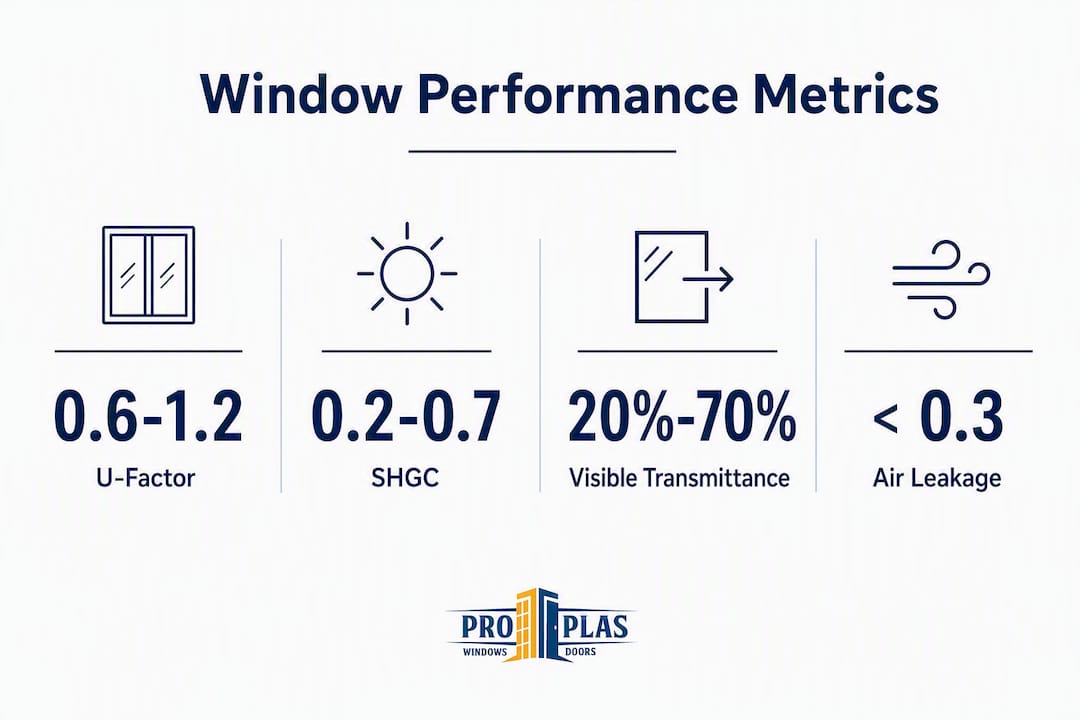
Visible transmittance (VT) measures the fraction of visible light that passes through. It typically ranges from 0.2 to 0.8. High-performance Low-E coatings can reduce VT, so there is a real trade-off between thermal performance and daylighting.
Air leakage is rated in litres per second per square metre (L/s·m²) at 75 Pa. The lower the number, the tighter the window. This figure is separate from installation air-sealing and reflects only the window unit itself.
Centre-of-glass vs whole-window: This distinction matters more than most homeowners realise. Centre-of-glass values measure only the glazing in the middle of the pane, ignoring frame conductance and edge losses. Whole-window values include everything. The gap between the two can be significant, especially with aluminium frames.
| Metric | Centre-of-glass example | Whole-window example | Notes |
|---|---|---|---|
| Double-pane Low-E argon | approximate centre-of-glass U-factor | typical whole-window U-factor range | Frame and edge contribute additional heat loss |
| Triple-pane Low-E argon | approximate centre-of-glass U-factor | typical whole-window U-factor range | Frame choice still matters |
| R-value (SI) equivalent | RSI 1.0 (triple CoG) | RSI 1.1 (triple WW) | Always compare on same basis |
| Air leakage target | N/A | ≤0.2 L/s·m² at 75 Pa | NFRC-rated whole-window |
How glazing, coatings, and gas fills change insulation performance
The glass stack is where most of the thermal work happens, but the gains are not linear.

Single-pane windows are effectively obsolete for Canadian climates. Centre-of-glass U-factors for single-pane windows are very high and generally unsuitable for Ontario climates. They offer almost no meaningful resistance to Ontario winters.
Double-pane Low-E with argon is the practical baseline. In cold Ontario climates, high-performance double-pane Low-E argon units typically reach whole-window U-factors of 1.1–1.4 W/m²·K. That is the right target for most Toronto-area replacements.
Triple-pane Low-E with argon commonly reaches 0.6–0.9 W/m²·K at the whole-window level, roughly a 40% improvement over double Low-E at the glass level. At the building level, the impact on total heating load is more modest. Industry analysis puts the whole-building heating savings from triple vs double at roughly 15–20%, not 40%, because windows are only part of the envelope.
| Glazing type | Centre-of-glass U (W/m²·K) | Whole-window U (W/m²·K) | Typical SHGC range |
|---|---|---|---|
| Single clear | high (non-insulating) | high (non-insulating) | high (0.6–0.8) |
| Double clear (air) | 2.7–3.0 | 2.8–3.2 | 0.6–0.7 |
| Double Low-E argon | 1.1–1.4 | 1.1–1.4 | 0.35–0.55 |
| Triple Low-E argon | 0.6–0.9 | 0.6–0.9 | 0.35–0.55 |
| Triple Low-E krypton | ~0.6 | ~0.8 | 0.35–0.5 |
Low-E coatings are microscopically thin metallic layers applied to one or more glass surfaces. Hard-coat (pyrolytic) Low-E is more durable but less selective. Soft-coat (sputter-deposited) Low-E offers better thermal performance and is standard on most high-quality Canadian windows. Spectrally selective coatings filter infrared heat while maintaining higher VT, which is useful when you want daylight without solar overheating on east or west exposures.
Argon vs krypton: Argon is the standard cost-effective gas fill for both double and triple units. Krypton offers better insulation in narrow gaps but at significantly higher cost, making it a practical choice only for very high-performance thin insulated glass units where argon’s optimal 12–16 mm gap is not achievable. For most residential replacements in Ontario, argon is the right call.
Pro Tip: Warm-edge spacers reduce edge heat loss substantially compared with aluminium spacers and can make a well-detailed double-pane unit outperform a poorly detailed triple. Always ask what spacer system is included before comparing U-factor numbers.
How frame materials affect whole-window thermal performance
Good glazing inside a poor frame is a wasted investment. Frame material choices directly affect the whole-window U-factor, long-term durability, and maintenance requirements.
- Vinyl (uPVC): The most common frame material in Canadian residential windows. Multi-chamber vinyl profiles trap still air and provide good thermal resistance. Low maintenance, no painting required, and cost-effective. The standard choice for most Ontario replacement projects.
- Wood: Naturally insulating and dimensionally stable when properly maintained. Higher maintenance requirements (painting, sealing) and greater susceptibility to moisture damage if installation is not done correctly. Often used in heritage or premium applications.
- Fiberglass/composite: The best thermal performer among frame materials. Fiberglass expands and contracts at nearly the same rate as glass, reducing seal stress over time. More expensive than vinyl but worth considering for high-performance builds or very cold exposures.
- Aluminium with thermal break: Aluminium conducts heat rapidly, so an aluminium frame without a thermal break is unsuitable for Canadian climates. A properly engineered thermal break (a low-conductivity barrier between the interior and exterior aluminium sections) brings performance closer to vinyl. Still not the first choice for cold-climate residential work, but acceptable in commercial applications with the right specification.
- Aluminium without thermal break: Avoid this in any Ontario application. The frame alone can drive the whole-window U-factor well above any meaningful performance target, regardless of how good the glazing is.
Warm-edge spacers and edge seals are the connection between frame and glazing. Aluminium spacers conduct heat from the edge of the glass, creating a cold strip that promotes condensation and raises the effective whole-window U-factor. Warm-edge spacers (foam, fibreglass, or hybrid materials) reduce that edge loss and also help maintain argon fill integrity over time. For a full breakdown of which features reduce heat loss most, the heat loss features guide covers frame, spacer, and glazing choices in practical detail.
How to read NFRC and ENERGY STAR labels correctly
Certifications are only useful if you know what to look for on the label.
- NFRC label: The National Fenestration Rating Council label lists U-factor, SHGC, VT, and air leakage for the whole window assembly, tested to a standardised method. The U-factor is always the top-left number. This is the figure to use when comparing products.
- ENERGY STAR Canada zones: ENERGY STAR sets climate-specific criteria and requires NFRC testing. Canada uses Northern and North-Central zone criteria that favour much lower U-factors than Southern zones. Ontario falls primarily in the North-Central zone. Check that the product is certified for the correct Canadian zone, not just the U.S. Southern zone.
- Manufacturer spec sheets: Manufacturers sometimes list centre-of-glass values alongside or instead of whole-window values. Always confirm which value is being quoted. If the spec sheet does not reference NFRC certification, ask for the NFRC label scan directly.
- Warranty and installation claims: Third-party certification (NFRC + ENERGY STAR) matters more than a manufacturer’s self-reported performance claim. Look for a product warranty that covers seal failure and gas fill retention, and an installation warranty that covers air-sealing and flashing work separately from the product itself.
Pro Tip: Ask the supplier to send you a scan of the actual NFRC label for the specific product and size you are ordering, not a generic data sheet. Performance values can vary by window size, and the label is the only document that reflects the tested assembly.
Typical U-value targets for Canadian climates, with Ontario examples
The table below gives practical whole-window targets for Ontario and guidance on SHGC by orientation. These are the numbers to use when comparing replacement windows for winter performance.
| Glazing type | Centre-of-glass U (W/m²·K) | Whole-window U target (W/m²·K) | Recommended for Ontario? |
|---|---|---|---|
| Double Low-E argon | 1.1–1.4 | 1.1–1.4 | Yes — standard baseline |
| Triple Low-E argon | 0.6–0.9 | 0.6–0.9 | Yes — coldest exposures, north-facing |
| Triple Low-E krypton | ~0.6 | ~0.8 | Niche — very high-performance builds |
| Single clear | very high U-factor values | not recommended |
SHGC orientation targets for Ontario:
- South-facing: SHGC 0.35–0.55 to capture passive solar heat in winter
- East/west-facing: SHGC 0.25–0.40 to balance gain and summer overheating
- North-facing: SHGC is less critical; prioritise the lowest U-factor available
For Ontario’s energy-efficient window targets and ENERGY STAR zone mapping, Natural Resources Canada’s certified product list is the authoritative reference.
Whole-window NFRC values are the only reliable purchasing metric. Centre-of-glass figures will always look better than what you will actually experience in your home.
Why installation quality determines whether rated performance is ever achieved
A window with an excellent NFRC label can perform like a mediocre one if it is installed poorly. Poor sealing, inadequate flashing, or thermal bridging at the frame can erase the rated gains from high-performance glazing entirely.
What good installation actually includes:
- Rough opening preparation: Remove all old flashing tape, sealant, and deteriorated framing. Inspect for rot or moisture damage before the new unit goes in.
- Sill pan flashing: Install a sloped sill pan that directs any water infiltration to the exterior. This is the single most common step skipped on budget installations.
- Air-sealing the perimeter: Apply low-expansion spray foam or backer rod and sealant between the window frame and rough opening on all four sides. High-expansion foam can bow frames and void warranties.
- Thermal break at the frame: Avoid direct contact between the window frame and any metal framing or masonry. Use a thermal break material where required.
- Exterior flashing and cladding integration: Head flashing must lap over the cladding below, not tuck behind it. Water management is as important as air-sealing.
- Interior trim and vapour barrier: Seal the interior perimeter to the vapour barrier before applying trim. Gaps here allow warm interior air to reach the cold frame and cause condensation.
- Post-installation check: Operate every sash, check for racking, and verify that weatherstripping compresses evenly around the full perimeter.
Pro Tip: Ask your installer whether they perform a blower-door or draft test after installation. A professional who offers post-installation air-leakage verification is demonstrating accountability for the whole-window result, not just the product. For a detailed breakdown of what to expect, the good installation guide covers every step.

When does higher-performance glazing actually pay off?
The payback calculation for triple-pane vs double-pane depends on several variables, and the honest answer is that it varies considerably.
- Climate zone: Ontario’s coldest regions (Zone 6 and above) see the largest heating-season savings. The colder the climate, the faster the payback on a lower U-factor.
- Window area as a share of envelope: Windows typically account for a meaningful portion of a home’s total heat loss, but upgrading them competes with attic insulation and air-sealing for dollars. In a poorly insulated house, attic work often pays back faster.
- Heating fuel costs: Natural gas at current Ontario rates makes the payback period longer than electric resistance heating. As energy prices rise, the payback shortens.
- Installation cost premium: Triple-pane typically costs 20–30% more than comparable double-pane. That premium must be recovered through energy savings over the window’s lifespan.
- Expected lifespan and argon retention: Quality insulated glass units retain most of their argon fill for 20+ years with intact seals. Seal failure accelerates performance degradation.
High-performance windows can reduce household heating and cooling costs by roughly 7–15% depending on location and the baseline they replace. That range is wide because it depends heavily on what you are replacing and how cold your winters are.
For most Toronto-area homes replacing 1990s double-pane clear glass, a high-quality double Low-E argon with warm-edge spacers delivers the best cost-to-benefit ratio. Triple-pane makes financial sense in Zone 6+ climates, on north-facing exposures, or where condensation on interior glass surfaces is a persistent problem. Noise reduction is another legitimate reason to choose triple-pane, particularly near busy roads or transit corridors, even when the energy ROI alone would not justify it.
Retrofit and temporary options: what they can and cannot do
Full window replacement is not always the immediate option. Retrofit and temporary measures have a real place, but their limitations are equally real.
- Shrink-film kits: Plastic film kits reduce drafts and seasonal heat loss but provide substantially less thermal resistance than a professional multi-pane replacement. They are a seasonal measure, not a long-term solution. Installation takes 15–20 minutes per window and the film is removed in spring. Useful for renters or as a stopgap while budgeting for replacement.
- Interior window inserts: Rigid acrylic or glass inserts that mount inside the existing frame create an additional air gap. They perform better than film kits and can be removed seasonally. They do not address frame air leakage or flashing issues.
- Storm windows: Exterior or interior storm windows add a second glazing layer and can meaningfully reduce heat loss on single-pane originals. They are a more durable retrofit than film kits and can be left in place year-round. Performance improvement depends heavily on how well the storm unit seals at the perimeter.
- Window insulation panels: Snap-on interior panels that attach directly to the glazing surface have been evaluated for commercial applications. GSA and PNNL research found that such panels improved centre-of-glass insulating performance by 52% in a tested federal building, though whole-building energy savings ranged from 2–7% depending on climate and baseline. They preserve window operability, which matters in some applications.
Retrofitting high-performance glass into old frames is often not feasible because of unit thickness and weight. A triple-pane IGU is significantly heavier than a double-pane unit, and many existing frames cannot accept the additional load without reinforcement. For window film as a solar-control retrofit, window tinting is a separate category worth considering when SHGC reduction is the primary goal.
Pro Tip: If your windows have failed seals (fogging between panes), no retrofit option addresses the root problem. Seal failure means the argon is gone and the glass is performing at or near single-pane levels. Replacement is the only fix that restores rated performance.
How to choose the right window: questions to ask and red flags to watch for
A structured approach to the buying process protects you from common mistakes.
Buyer checklist:
- Confirm the whole-window NFRC U-factor and SHGC for the specific product and size you are ordering.
- Verify ENERGY STAR certification for the correct Canadian climate zone (North-Central for most of Ontario).
- Ask for the frame material and confirm it includes a thermal break if aluminium is specified.
- Ask what spacer system is used (warm-edge vs aluminium).
- Confirm the gas fill (argon standard; krypton for premium thin units) and whether the manufacturer warrants gas retention.
- Get the installation scope in writing: does it include sill pan flashing, perimeter air-sealing, and head flashing?
- Ask for separate product and installation warranties, and confirm what each covers.
Questions to ask your supplier directly:
- “Can you send me the NFRC label scan for this exact product and size?”
- “What spacer system does this unit use?”
- “Does your installation warranty cover air-sealing and flashing, or only the product?”
- “Is this product ENERGY STAR certified for the North-Central Canadian zone?”
Red flags:
- Supplier quotes only centre-of-glass U-factor with no mention of whole-window values.
- No NFRC label available for the product.
- Aluminium frames with no thermal break specified for a Canadian climate application.
- Installation warranty covers only the product, not the installation workmanship.
- Vague air-sealing description (“we caulk around the frame”) with no mention of flashing or sill pan.
Key takeaways
For Canadian homes, the whole-window NFRC U-factor is the single most important number to request, and installation quality is what determines whether that number is ever achieved in practice.
| Point | Details |
|---|---|
| Baseline for most Ontario homes | Double-pane Low-E argon with warm-edge spacers; target whole-window U-factor ≤1.4 W/m²·K. |
| When to choose triple-pane | Climate Zone 6+, north-facing exposures, persistent condensation, or noise reduction needs; target ≤0.9 W/m²·K. |
| Whole-window vs centre-of-glass | Always request the NFRC whole-window value for a realistic measure of performance. |
| Installation determines outcome | Poor flashing, missing sill pan, or inadequate air-sealing can erase the rated gains of any high-performance window. |
| Proplas for Toronto and Southern Ontario | Proplas supplies and installs ENERGY STAR certified, NFRC-rated custom windows with a lifetime warranty and installation timelines as fast as three days. |
Proplas’s perspective on what the numbers miss
After 25 years and more than 10,000 installations across Toronto and Southern Ontario, the pattern we see most often is not a bad product choice. It is a good product installed without the supporting details that make the rated performance real.
Homeowners and building professionals spend considerable time comparing U-factors and SHGC values, which is exactly the right starting point. But the NFRC label is a laboratory result. What happens on site is a different matter. We have seen triple-pane units with excellent ratings underperform because the rough opening was not properly air-sealed, or because the sill pan was omitted and water infiltration compromised the frame over time. The glazing was fine. The installation was not.
The other issue that comes up regularly is weight. Triple-pane units are significantly heavier than double-pane, and many older Toronto homes have frames that were not built to carry that load. Recommending triple-pane without assessing the structural context is not good advice. Sometimes the right answer is a high-quality double Low-E argon with warm-edge spacers and a proper installation, which will outperform a triple-pane unit dropped into an unprepared opening.
Our recommendation is always to treat the window and the installation as one system. The product warranty and the installation warranty should be held by the same party, so there is no gap in accountability if something goes wrong.
Ready for an NFRC-backed quote from Proplas?
Proplas offers Toronto and Southern Ontario homeowners something straightforward: custom windows that are ENERGY STAR certified and NFRC-rated, installed by an experienced team with a lifetime warranty and no hidden fees.

Every Proplas quote covers the full scope: product selection matched to your climate zone and orientation, sill pan flashing, perimeter air-sealing, and head flashing included as standard. Installation is typically completed in as little as three days. There are no surprise charges after the contract is signed.
If you are comparing casement windows or awning windows for specific exposures, Proplas carries both in configurations that meet Ontario’s North-Central ENERGY STAR criteria. For a window replacement with warranty that covers both product and workmanship, contact Proplas for a transparent, no-obligation quote.
Sources and further reading
- Natural Resources Canada — ENERGY STAR certified windows, doors, and skylights
- GSA / PNNL — Window Insulation Panels Field Evaluation
- Proplas — Energy Efficient Windows Guide for Ontario Homes
- Proplas — ENERGY STAR Replacement Windows Explained
- Proplas — What Good Window Installation Should Include